An Open Letter from Stakeholders, Survivors, and their Advocates
1 October 2023
To the New Zealand Abuse in Care Royal Commission of Inquiry and the New Zealand Attorney-General, The Honourable David Parker:
Firstly, thank you for the time and effort the royal commission has expended in its impartial investigation and examination into historical abuse and neglect in State care, and in the care of faith-based institutions in New Zealand.
Secondly, thank you for your understanding, acknowledgement, and your response to the harm abuse and neglect causes to individuals, families, and communities; and your efforts to ensure lessons are learned for the future.
We were disappointed that the Jehovah’s Witnesses are seeking a judicial review and High Court declaration in relation to being the subject of any review by the Abuse in Care Commission of Inquiry. According to the official media statement issued by the Jehovah’s Witnesses Public Information Department:
“the religion of Jehovah’s Witnesses does not and never has taken children, young people or vulnerable adults into care.”
We dispute this statement made by the religion of Jehovah’s Witnesses.
Link (Official website) | New Zealand Abuse in Care Royal Commission of Inquiry
Institutional Abuse
Institutional child abuse, including child sexual abuse, is a worldwide problem, or to put it more accurately, it is a plague on humanity. It is promising to see countries around the world shining a spotlight on that plague.
For example, in December 2017, across the Tasman Sea, your neighbour, Australia, received from the Australian Royal Commission into Institutional Responses to Child Sexual Abuse a comprehensive Final Report that was the culmination of a five-year inquiry into institutional responses to child sexual abuse and related matters.
Article | Jehovah’s Witnesses and the Child Abuse Royal Commission
During this five-year inquiry, the Australian Child Abuse Royal Commission:
- Handled 42,041 calls
- Received 25,964 letters and emails
- Held 8,013 private sessions
- Received 1,334 personal written accounts
- Published 3,955 private session narratives
- Made 2,575 referrals to the authorities including the police
- Held 57 public hearings, known as case studies
Of these case studies, Case Study 29 into the Jehovah’s Witnesses, was the most streamed hearing abroad. Among the nations this hearing was streamed to, and watched, was New Zealand.
As part of the preparation for the Jehovah’s Witnesses public hearing, the Child Abuse Royal Commission compelled a controlling legal entity of the Jehovah’s Witnesses institution, Watchtower Bible and Tract Society of Australia, to produce under subpoena, its child sexual abuse database and all documents relating to allegations of child sexual abuse under the control of the institution.
Watchtower Australia produced around 5,000 documents, which included case files pertaining to 1,006 alleged perpetrators of child sexual abuse within, or associated with, the religion in Australia. The Child Abuse Royal Commission analysed the files and produced a data base summary of all 1006 cases, of which were mostly uncontested by Watchtower Australia.
The vast majority of these 1,006 cases, namely 961, occurred across a 35-year period from 1980 through 2015. Shocking statistics, to say the least.
This database also revealed that the Jehovah’s Witnesses institution had compiled internal records relating to just over 1,800 alleged child sexual abuse victims, with zero allegations reported to the authorities or police by the institution.
It is worth noting that of these 1,800 alleged child sexual abuse victims, around 100 pre-dated the year 1980.
Unfortunately, both the Jehovah’s Witnesses institution and the Governing Body of Jehovah’s Witnesses have refused to say sorry to a single institutional child sexual abuse survivor within Australia, despite numerous pleas having been made, privately and publicly, including through the media. By contrast, The Australian Government did issue a National Apology.
Instead, the Jehovah’s Witnesses have gone after – in a manner that could be described as religious-based persecution – individual child sexual abuse survivors that spoke up or that had raised their concerns publicly.
To the New Zealand Abuse in Care Royal Commission of Inquiry, you are to be commended for your inclusion of the Jehovah’s Witnesses institution, as part of your impartial investigation and examination into historical abuse and neglect in the care of faith-based institutions. Again, we say thank you.
Jehovah’s Witnesses in New Zealand – Children in crisis
In 1999, Jehovah’s Witnesses across New Zealand offered to the public the April 8 issue of their magazine Awake!, dealing with the subject Children in Crisis – Who Will Protect Them? The image below is a copy of the Australia / New Zealand version of the magazine.
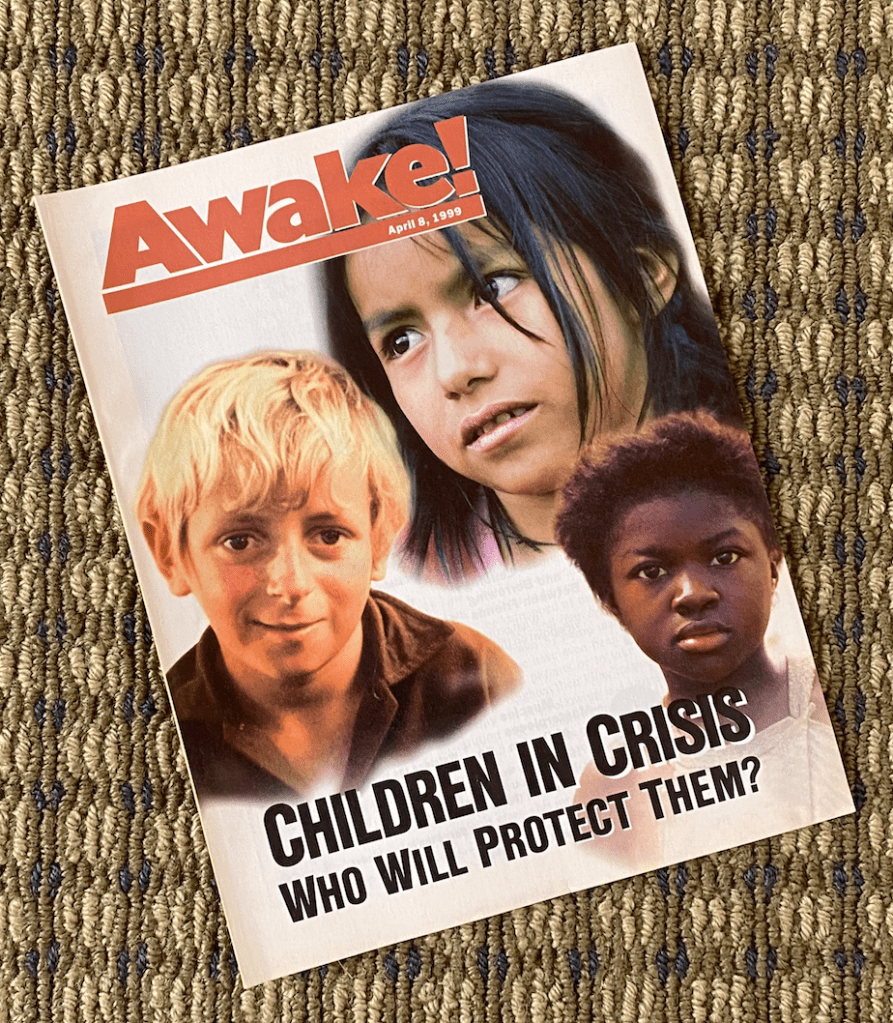
Page 8 of the Awake! magazine, under the heading “Who Will Protect Our Children?”, contained the following comments:
“[T]here are those who seek a better life for children by passing legislation to protect them.
… While we all no doubt applaud such efforts to rid society of child abuse, we must be realistic and acknowledge that child abuse has very deep roots in human society. It would be naive to think that a simple solution such as legislation will provide complete protection for our children. Many laws have already been passed, and yet the problem persists. It is really an indictment of the world’s delinquent adults that the natural right to childhood has to be protected by a vast array of laws.”
Reference: Awake! magazine, April 8, 1999, page 8.
Ironically, it was the passing of such legislation, in one country after another, that forced the Jehovah’s Witnesses to create and adopt a Child Safeguarding Policy. An indictment indeed on the religion and its leaders.
New Zealand High Court case – What are the Jehovah’s Witnesses concerned about?
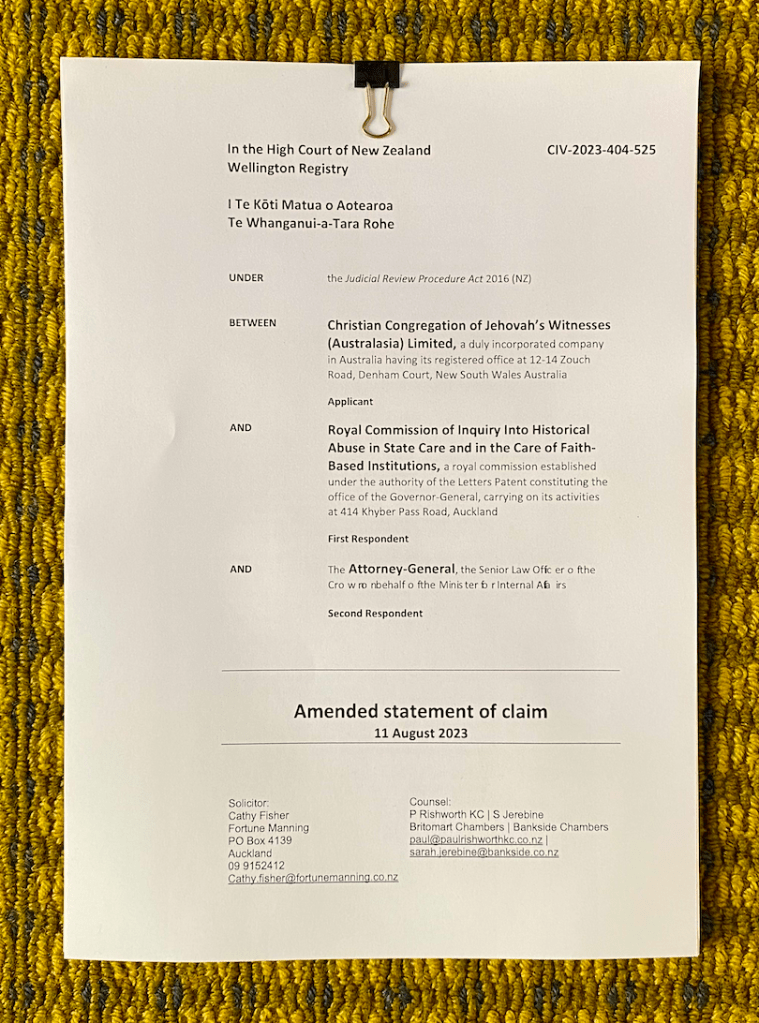
Many of the survivors of child sexual abuse, from within and out of the religion of Jehovah’s Witnesses in New Zealand, are aware that the Governing Body of Jehovah’s Witnesses have authorised an application to the New Zealand High Court for a judicial review of the Royal Commission of Inquiry’s Terms of Reference, while simultaneously claiming that there are no instances of the religion of Jehovah’s Witnesses assuming responsibility for the care of children or young people.
It is noted by both survivors of the Jehovah’s Witnesses institution, and their advocates, that the schedule for the Terms of Reference stipulate that the purpose and scope of the Royal Commission of Inquiry in its investigation and examination is to inquire into matters between 1 January 1950 and 31 December 1999 inclusive.
The later date, 31 December 1999, is potentially of concern to the religion of Jehovah’s Witnesses, both from a corporate point-of-view and from a religious point-of-view.
During this period, from 1950 through to 1999, members of the Governing Body of Jehovah’s Witnesses were officers and directors of the Jehovah’s Witnesses parent organisation, Watch Tower Bible and Tract Society of Pennsylvania, Inc.
“At the conclusion of the annual meeting of the Watch Tower Bible and Tract Society of Pennsylvania on October 7, 2000, a special announcement was made by the chairman, John E. Barr of the Governing Body.
. . . Brother Barr told the audience that recently certain members of the Governing Body of Jehovah’s Witnesses who had been serving as directors and officers voluntarily stepped aside from the boards of directors of all the corporations.”
Reference: The Watchtower magazine, January 15, 2001, page 31.
At this point in time, as it had been for many decades, the New Zealand Branch Office of Jehovah’s Witnesses was the corporate branch office for Watch Tower Pennsylvania, replete with an accounting department and a legal department.
As such, the Governing Body of Jehovah’s Witnesses and its religious successors, both ecclesiastically and through the corporations they control and direct, are vicariously liable for all instances of institutional child sexual abuse within the Jehovah’s Witnesses in New Zealand between 1 January 1950 and 31 December 1999.
It is not possible for the Jehovah’s Witnesses in New Zealand to deny their corporate and ecclesiastical history given the evidence available. Although, it is quite possible that an attempt to engage in historical negationism, or to conflate or confuse their history, or even their present, could be made.
An example of this recently occurred in the lead up to the filing of an application to the New Zealand High Court for a judicial review.
The New Zealand charity, Christian Congregation of Jehovah’s Witnesses, altered by resolution the Association’s rules to remove key controlling and oversight references to both the Governing Body of Jehovah’s Witnesses and Watch Tower Bible and Tract Society of Pennsylvania.
Download | Christian Congregation of Jehovah’s Witnesses 2023 alteration to rules.pdf
This plays into the current strategy of the leaders of Jehovah’s Witnesses to deny, by outright deception, the history of children within the religion and institution, especially with regards to the authority, supervision, and control the religion has had, and does have over children.
Understanding these events is critical in understanding the current actions of the Governing Body of Jehovah’s Witnesses in authorising the seeking of a judicial review in the High Court of New Zealand, that, among other things, includes the attempt to obtain a determination that the religion has never taken children into its care nor has it ever assumed responsibility for children.
Ongoing Concerns
Our ongoing concern is the level of false and misleading information that has been provided to the Commission by the religion of Jehovah’s Witnesses since 2019, and of which information is finding its way into the Applicant’s Statement of Claim and brief in the proceedings before the High Court of New Zealand (CIV-2023-404-525) due to commence on 9 October 2023.
In 2019, the Australian registered company, Christian Congregation of Jehovah’s Witnesses (Australasia) Limited (CCJWA), sent a letter to the New Zealand Abuse in Care Royal Commission of Inquiry. This letter, dated 18 October 2019 explained that:
“the religion of Jehovah’s Witnesses has never assumed responsibility for the care of children or vulnerable adults.”
This claim by the religion of Jehovah’s Witnesses is patently false. A similar letter was also presented to the Commission by counsel for CCJWA on 25 February 2021.
Further, on 1 December 2021, in response to Notice to Produce No. 1, CCJWA informed the Commission that:
“13. Elders in congregations of Jehovah’s Witnesses do provide pastoral support to congregants, albeit they are instructed never to do so one-on-one in private or (in the case of children) in the absence of a child’s parent(s) or guardian(s).”
This statement demonstrates, at minimum, a reckless disregard for providing an accurate and truthful accounting of the role of an elder in relation to children within the congregation.
These false claims by the religion of Jehovah’s Witnesses and CCJWA, and other false claims as appearing in CCJWA’s statement of claim, will be addressed in Part 2 of this Open Letter.
Part 1 – Conclusion
We therefore respectfully request the New Zealand Abuse in Care Royal Commission of Inquiry and the New Zealand Attorney-General, The Honourable David Parker, consider the following comments and statements, from non-party stakeholders, on the current proceedings under the Judicial Review Procedure Act 2016 (New Zealand) as presented in Part 2.

This article was produced in conjunction with JW News.
Please support Say Sorry and JW News for as little as the cost of a coffee

 SaySorry.org